me Back to the tree
drop assets/intellectual-loop.mp4 here
Dimension 07Internal dimension

Intellectual Wellbeing

Having access to more information than any previous generation turns out to have no automatic relationship with intellectual engagement. Curiosity requires something that information alone does not supply.

Intellectual wellbeing covers your engagement with ideas, learning, and mental challenge: curiosity, critical thinking, creativity, and the capacity to keep growing across a lifespan. It is often confused with intelligence or educational attainment, though what the research tracks is something different: active cognitive engagement, available at any age. Of all eight dimensions, it is the most readily set aside once formal education ends, typically replaced by high-volume information consumption that mimics intellectual activity without demanding the active processing that builds the mind over time.
Owl
The owl in the hollow says

"The mind, like a muscle, retains function through use and loses it through extended disuse. Boredom is not the enemy – it is the beginning."

– your guide to the eight dimensions

On curiosity, boredom, and the life of the mind

Passive scrolling
What is this mind doing?
Deep engagement
And this one?

Intellectual wellbeing is the dimension most easily confused with education, intelligence, or the possession of informed opinions. What the research describes is a quality of cognitive state: a mind working on something whose answer is not yet known, uncertain enough to require effort, challenged enough to require growth. The difference between that state and passive information consumption can be difficult to feel in the moment, but the evidence on cognitive reserve suggests it matters considerably over a lifespan.

Key research finding

A landmark 2003 study by Joe Verghese and colleagues, published in the New England Journal of Medicine, followed 469 adults aged 75 and older for 21 years and found that participation in cognitively stimulating leisure activities – reading, playing musical instruments, playing board games, writing for pleasure – was associated with a 35% reduction in dementia risk, even after controlling for baseline cognitive status. The study showed a dose-response relationship: more frequent engagement, lower risk. The mechanism proposed is cognitive reserve: the brain, like a muscle, retains function through use and loses it through extended disuse.

23%
book reading of more than 3.5 hours per week is associated with a 23% reduction in mortality risk over a 12-year follow-up
Bavishi et al., Social Science & Medicine, 2016 · read the source
17 min
average daily reading time for US adults, compared to over 3 hours of entertainment media consumption
BLS American Time Use Survey, 2022 · read the source

What the evidence actually says

The cognitive neuroscience literature distinguishes between passive information exposure and active cognitive engagement, and the distinction matters for brain health. Reading a novel involves prediction, inference, the sustained holding of context, and the construction of a coherent mental model; scrolling a news feed does not. The concept of cognitive reserve, developed by Stern and colleagues, holds that the brain builds a buffer against age-related decline through sustained intellectual engagement across a lifetime. This buffer responds to use: it accumulates with consistent intellectual engagement and diminishes with consistent absence of it.

Challenge
Regular exposure to problems and questions whose answers are not immediately available.
Builds cognitive reserve; associated with reduced dementia risk.
Curiosity
Active interest in questions you do not already know the answer to, pursued consistently.
Associated with life satisfaction, learning retention, and intrinsic motivation.
Deep reading
Extended, focused reading of texts that require inference and context-holding.
Builds empathy, vocabulary, and cognitive flexibility; a rare form of sustained attention.
Skill development
Learning something genuinely new and difficult, not merely practising existing competencies.
Activates neural plasticity; produces the intrinsic reward of growth under challenge.

Of consumption, boredom, and the curiosity gap

The information environment of the current decade is historically unprecedented in its volume, its velocity, and its capacity to produce the feeling of intellectual activity without any of its substance. A person who consumes twelve articles a day, two hundred social media posts, three hours of podcast and four of television, can reasonably feel informed; the feeling of being genuinely challenged by any of it is considerably rarer.

Consumption is not engagement

The distinction between passive information consumption and active intellectual engagement is a functional one: active engagement requires the mind to hold a model, predict an outcome, notice a contradiction, and update a belief. These are effortful operations, and they are the ones that produce learning, build cognitive flexibility, and contribute to the reserve that protects against cognitive decline. Media designed primarily to hold attention tends to minimize exactly this kind of effort; the experience of feeling informed and the experience of being genuinely challenged are, neurologically, quite different events.

Books and lamp, cosy reading
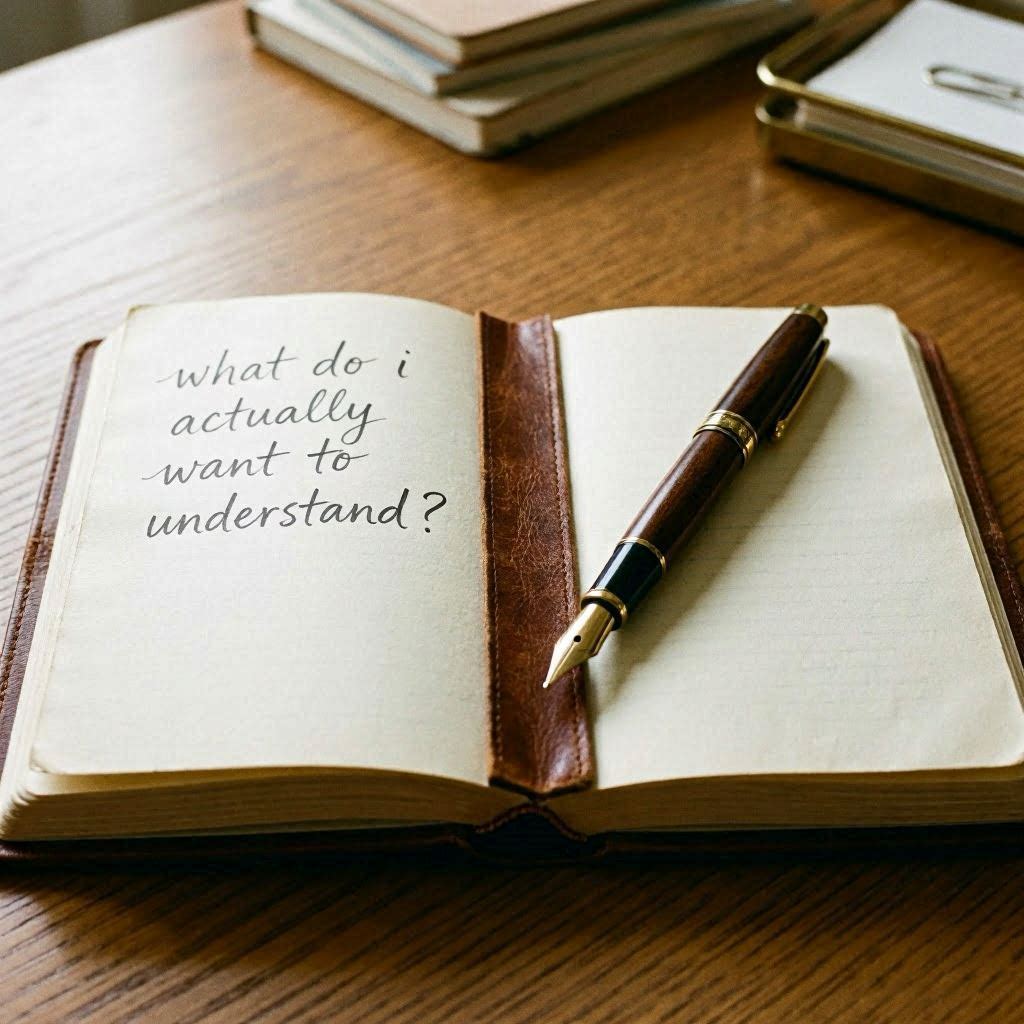
Notebook with thoughts

Boredom as diagnostic

Boredom, which contemporary culture treats as an emergency requiring immediate remediation, is actually a diagnostic signal: it indicates that the mind is understimulated relative to its capacity. The problem with remedying it instantly, through the nearest available screen, is that the remedy typically maintains the understimulation while removing the discomfort of it. Research by Mann and Cadman (2014) found that boredom increased scores on divergent thinking tasks, suggesting that the unoccupied mind, given a moment to rest in its own uncertainty, generates creative output that a constantly occupied mind tends to foreclose. Tolerating the discomfort of boredom long enough to let it become something turns out to be one of the more underrated cognitive skills available to an adult life.

The curiosity gap

George Loewenstein's theory of the curiosity gap describes curiosity as the felt gap between what you know and what you want to know. This is a useful frame for intellectual wellbeing because it is actionable: you can, deliberately and at any age, identify questions whose answers genuinely interest you and pursue them. The questions can be modest; what matters is that they are genuine, things you actually want to know, that you are willing to sit with in uncertainty long enough to find out. The gap, taken seriously, is one of the most reliable sources of intellectual aliveness available to an adult life.

"A question you genuinely want answered, held open long enough to pursue, is one of the more reliable sources of intellectual energy available to a person at any age."

Three exercises for intellectual wellbeing

None of these require a course, a curriculum, or a particular level of prior education. They require only the willingness to locate the questions you have been consuming information about without ever seriously attempting to answer.

Exercise 01
15 min

The Question You Have Been Avoiding

  1. Name a topic, question, or area of knowledge you have been meaning to explore seriously but keep deferring. Not a task – a genuine question: something whose answer you do not know and that interests you.
  2. Write down what you already know about it, and then write down the three specific things you do not know but would most like to understand.
  3. Choose a single source – one book, one academic paper, one long-form article – and commit to reading it fully, without switching tabs, within the next ten days.
  4. The purpose of this exercise is not to become expert in anything. It is to spend an extended period in genuine uncertainty, which is where actual learning lives.
Exercise 02
10 min

The Reading Audit

  1. Name everything you have read in the last month. Include books, long articles, academic papers, substantive journalism – not social media or news headlines.
  2. For each, ask: did this require me to hold an argument in mind across more than a few paragraphs? Did I encounter something I disagreed with or did not understand? Did I finish it?
  3. If the list is short, or if most entries fail the second question, you are in an intellectually passive period. That is not a criticism; it is data.
  4. Choose one book you have been meaning to read for more than a year. Start it this week. Not because it will make you better, but because the kind of attention it requires is good for you.
Exercise 03
10 min

The Skill Inventory

  1. Name one skill you are currently developing that genuinely challenges you – one where you regularly encounter the edge of your competence and fail.
  2. Name one skill you regularly deploy that no longer challenges you: one you are competent at but not growing in.
  3. Notice whether you have been spending the majority of your intellectual effort in category two. Comfort is useful; it is not the same as growth.
  4. Identify one small context in which you could deliberately move to the harder edge of an existing skill, or begin a new one. The bar is not mastery. The bar is regularly failing at something you care enough to persist through.
Owl
What comes next

Ready to put this into practice?

Four tools for this dimension – from a free printable guide to a full seasonal workbook. Each designed to make the change last.

scroll to explore
Practice this dimension

Four ways to begin with intellectual wellbeing

Each product can be used alone, or layered as a season-long practice. Begin with the free guide; the rest is patient work.

Free · 34 pages

The Free Guide

A printable PDF covering all eight dimensions of wellbeing – evidence, exercises, and a map for the whole tree. Yours in exchange for an email address you will not regret giving.

Free
Take the quiz, the guide follows by email →
30 days · daily prompt

30 Days of Practice

Four thematic weeks. One small practice each day, 5–20 minutes, building from one orientation to the next. By day thirty, the practice has had time to settle – a beginning, with enough evidence of its own to continue.

From €19
Notify me when ready
Waiting list · under production.
Quarterly · 13 weeks

Quarterly Workbook

A bound workbook for one season: weekly thinking audits, deeper essays on curiosity and growth, three reflective rituals.

From €49
Notify me when ready
Waiting list · research ongoing.
online · 60 minutes

Webinar

A online conversation about what you are presently thinking with, and what you have stopped thinking about.

By inquiry
Notify me about the next session
Next session · join the list.
After reading · score yourself in the other seven

Where else does the body need looking after?

You have just read about one dimension. The other seven sit on the same tree. A short, quiet self-assessment will tell you which to attend to next, and the result lands in your inbox.

Take the quiz
25 questions · no shame in any score
Recommended reading · affiliate

Books for intellectual wellbeing

Five titles we return to. We earn a small fee if you buy through these links.

Research sources

Verghese et al., New England Journal of Medicine, 2003 · link · Stern, Neuropsychologia, 2009 · link · BLS American Time Use Survey, 2022 · link · Loewenstein, Psychological Bulletin, 1994 · link · Mann & Cadman, Creativity Research Journal, 2014 · link · Wolf, Reader Come Home, 2018