me Back to the tree
drop assets/financial-loop.mp4 here
Dimension 03External dimension

Financial Wellbeing

Money anxiety is cognitive load you carry before breakfast.

Financial wellbeing tracks the degree to which money occupies the mind, not the amount in the account. The person earning two hundred thousand euros and spending two hundred and ten carries more financial anxiety, on every measurable indicator, than the person earning thirty thousand who has a month of expenses saved, a rough sense of where the money goes, and no debt that keeps them awake at night.

Owl
The owl in the hollow says

"Money is the most common source of chronic stress in modern life. And chronic stress is the most effective way of making certain that money problems compound."

– your guide to the eight dimensions
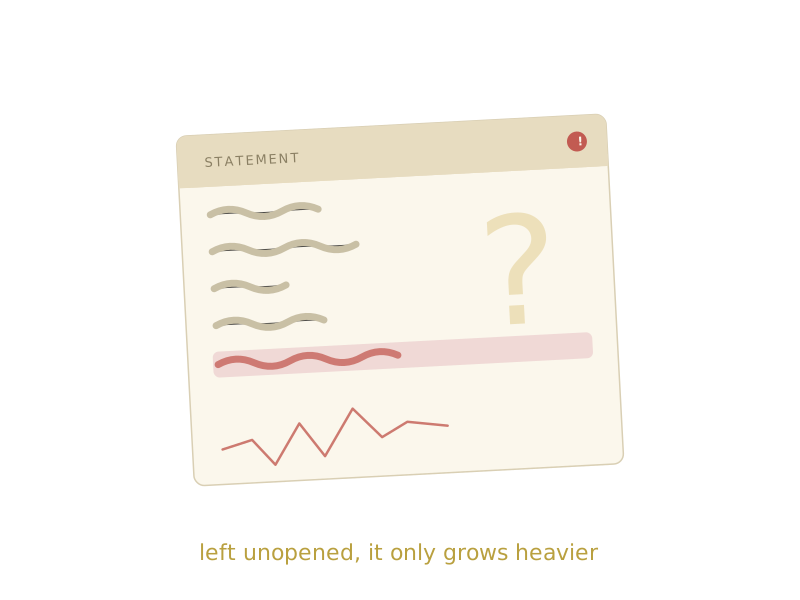
On the quiet weight of unresolved money

A statement left unopened – the number avoided
How does it feel to open your banking app?
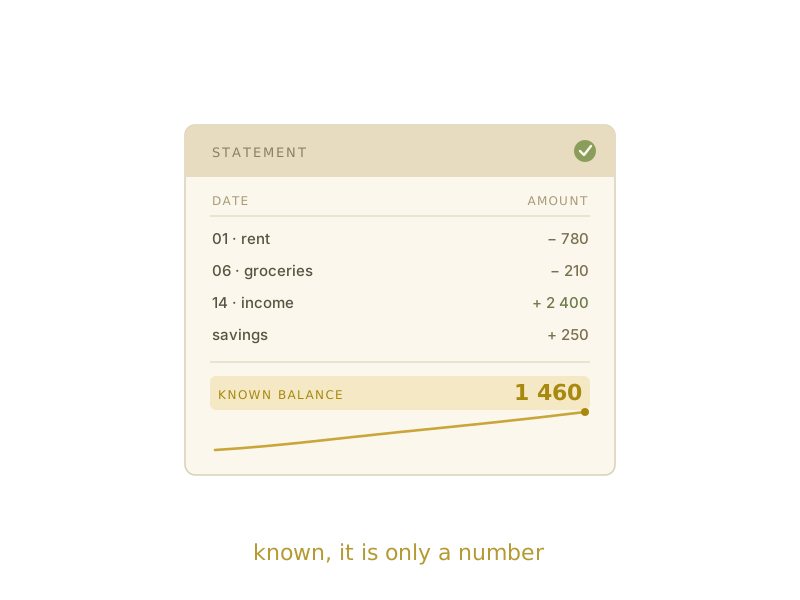
A statement read – the number known and in order
How would it feel if you knew the number before you looked?

The financial dimension of wellbeing is unusual in that the research diverges sharply from the cultural conversation around it. The culture talks about wealth: earning more, spending less, accumulating assets. The research talks about something more modest and more tractable – financial stability, predictability, and the cognitive relief of knowing roughly where things stand. Above a certain threshold, additional money produces very little additional wellbeing. Below that threshold, financial stress consumes mental resources with extraordinary efficiency.

Key research finding

Sendhil Mullainathan and Eldar Shafir's research on the psychology of scarcity found that financial worry consumes cognitive bandwidth equivalent to losing 13 IQ points – the same cognitive impairment caused by going a full night without sleep. The mind that is managing financial threat is a mind with meaningfully less capacity for everything else.

~$75k / year
annual income beyond which additional earnings produce no measurable improvement in day-to-day emotional wellbeing
Kahneman & Deaton, PNAS, 2010 · read the source
33%
of adults report money as their primary source of stress, consistently, year after year
APA Stress in America survey, 2022 · read the source

What the evidence actually says

The research on financial wellbeing consistently isolates four variables that matter more than income level: clarity (knowing what you earn, spend, and owe), cushion (having a buffer that absorbs unexpected costs without crisis), direction (having a rough sense of where you are going), and adequacy (the subjective sense that what you have is enough for the life you are actually living). Of these, clarity is the most immediately actionable – and the most often avoided.

Clarity
Knowing your numbers: what comes in, what goes out, what you owe.
Reduces financial anxiety by 40% even before any change in income (Archuleta et al.).
Cushion
One month of living expenses in a separate, boring account you do not touch.
Eliminates the most common source of financial crisis; changes relationship to unexpected costs.
Direction
A rough orientation toward a future financial state: debt-free, stable, building.
Purpose in financial life predicts sustained behaviour change better than rules.
Adequacy
The subjective sense that what you have is enough for the life you actually value.
Not a number – a relationship between resources and values; requires values to be examined first.

Of clarity, cushion, and the scarcity mind

Three aspects of financial wellbeing carry disproportionate weight in the research: the cognitive effects of financial scarcity, the stabilising power of a simple buffer, and the relationship between money and personal values. Each can be approached this week.

The scarcity mindset

Scarcity, the experience of having less than you feel you need, does not just create stress. It changes how the mind works. Mullainathan and Shafir showed that people under financial pressure make systematically worse decisions: they borrow at higher interest rates, miss appointments that cost them money, and neglect long-term planning in favour of immediate relief. All of this follows predictably from a mind that is fully occupied: worse decisions, higher-interest borrowing, long-term planning sacrificed for immediate relief. The most useful intervention, before any financial advice can take hold, is reducing the cognitive load enough to think clearly.

The weight of scarcity
Organized savings

The one-month rule

The single most protective financial behaviour is also one of the simplest: having one month of basic living expenses in a liquid, separate account. Not invested. Not complicated. Available. Research on financial resilience consistently shows that this buffer, not size of income, not savings rate, not investment portfolio, is the variable most strongly associated with financial wellbeing. It converts unexpected costs from crises into inconveniences. That conversion is worth more than its face value.

Money and values

Most financial advice focuses on behaviour: spend less, save more, invest early. The research on lasting financial change points somewhere else: to values. The gap between how people actually spend their money and what they say they care about is, in most households, substantial. Closing that gap, not through guilt or restriction, but through clarity, is the most sustainable financial intervention available. A budget that reflects your values is a self-portrait you can afford to live in.

"Most financial stress lives in the distance between how you spend and what you actually value."

Three exercises for a clearer financial life

None of these require a financial advisor, a spreadsheet you will abandon, or more willpower than you currently have. They require only the willingness to look.

Exercise 01
30 min

The One-Page Overview

  1. Write down everything that comes in each month. Then everything that goes out – not from memory, from your actual bank statement.
  2. Subtract. Look at the number without judgement. It is information, not verdict.
  3. Circle the three expenditures that surprise you most – not the largest, but the ones that feel most misaligned with what you actually value.
  4. Clarity is the beginning. You cannot navigate from a map you have never looked at.
Exercise 02
20 min

The Buffer Plan

  1. Calculate one month of essential expenses: housing, food, utilities, transport. Write the number down.
  2. Divide it by twelve. That is your monthly target contribution to a buffer account. Even if it takes three years to build, begin now.
  3. Open a separate account – different bank if possible – and automate the transfer on the day you are paid. Name it something boring.
  4. The buffer does not earn much interest. It earns something more valuable: the removal of a category of fear.
Exercise 03
25 min

The Values Alignment Check

  1. Write down the five things you value most in your life – not what you think you should value, but what actually matters when you imagine your best days.
  2. Look at your last month's spending. For each major category, ask: does this support one of the five?
  3. The goal is not guilt. The goal is to find the gaps between intention and behaviour – the subscriptions you forgot, the spending that belongs to a version of yourself that no longer exists.
  4. Financial wellbeing is not just about having enough. It is about spending in a direction you recognise.
Owl
What comes next

Ready to put this into practice?

Four tools for this dimension – from a free printable guide to a full seasonal workbook. Each designed to make the change last.

scroll to explore
Practice this dimension

Four ways to begin with financial wellbeing

Each product can be used alone, or layered as a season-long practice. Begin with the free guide; the rest is patient work.

Free · 34 pages

The Free Guide

A printable PDF covering all eight dimensions of wellbeing – evidence, exercises, and a map for the whole tree. Yours in exchange for an email address you will not regret giving.

Free
Take the quiz, the guide follows by email →
30 days · daily prompt

30 Days of Practice

Four thematic weeks. One small practice each day, 5–20 minutes, building from one orientation to the next. By day thirty, the practice has had time to settle – a beginning, with enough evidence of its own to continue.

From €19
Notify me when ready
Waiting list · under production.
Quarterly · 13 weeks

Quarterly Workbook

A bound workbook for one season: weekly audits, deeper essays, three reflective rituals. Designed for slower progress that compounds rather than burns out.

From €49
Notify me when ready
Waiting list · research ongoing.
online · 60 minutes

Webinar

A guided look at your financial situation, with the four levers as the lens. We arrive at three changes you would have arrived at alone, in roughly half a year.

By inquiry
Notify me about the next session
Next session · join the list.
After reading · score yourself in the other seven

Where else does the body need looking after?

You have just read about one dimension. The other seven sit on the same tree. A short, quiet self-assessment will tell you which to attend to next, and the result lands in your inbox.

Take the quiz
25 questions · no shame in any score
Recommended reading · affiliate

Books that shaped this dimension

Five titles that informed the writing here, with our honest commentary. We earn a small fee if you buy through these links.

Research sources

Mullainathan & Shafir, Scarcity, 2013 · Kahneman & Deaton, PNAS, 2010 · Archuleta et al., J. Financial Therapy, 2013 · APA Stress in America, 2022